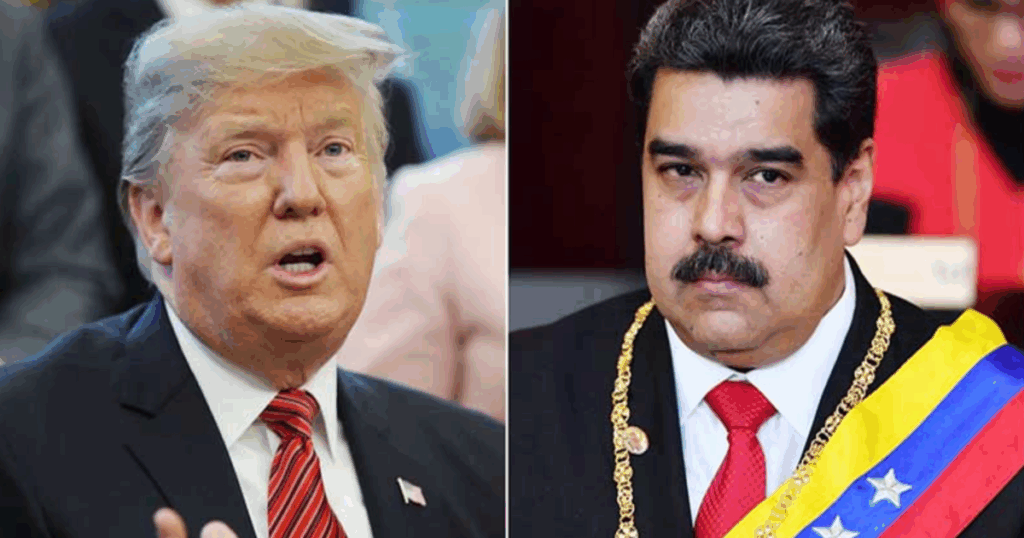










As tensions between Washington and Caracas continue to rise, questions are emerging over whether the United States is preparing to topple Venezuelan President Nicolás Maduro. The short answer seems to be: not intentionally, but possibly by accident—and that, according to analysts, is the real danger.

Recent developments in U.S.-Venezuela relations reflect a familiar pattern. The Trump administration is reportedly considering limited military operations against drug trafficking networks operating within Venezuela. However, this move is widely perceived as part of a broader effort to weaken the Maduro government.
Although former President Donald Trump has not formally authorized any direct military action, diplomatic backchannels, facilitated by Middle Eastern intermediaries, remain active. The administration’s strategy seems aimed at increasing pressure without defining clear objectives—a tactic that risks unpredictable escalation.
U.S. officials have framed this policy not as a plan for regime change but as part of a counter-narcotics and anti-terrorism campaign. Leading this hardline approach is Secretary of State Marco Rubio, whose Cuban-American perspective heavily shapes his stance on Venezuela. Rubio views Maduro’s rule as sustained by Cuban intelligence and oil resources that support Havana’s economy. From this perspective, removing Maduro represents “the first step in cleansing the hemisphere.”
Yet, ideology and reality appear to be at odds. While Trump denied pursuing regime change, he simultaneously ordered the deployment of significant military assets near Venezuela’s coast. This contradiction has fueled confusion over Washington’s true intentions—whether it seeks to pressure Maduro into negotiations, provoke a military coup, or trigger public unrest through economic collapse.
Critics warn that the administration is drifting toward an unplanned regime change scenario without a post-Maduro reconstruction strategy. The situation mirrors past U.S. interventions that led to prolonged instability. Like Iraq and Libya, Venezuela’s economy is dependent on oil, its institutions are weak, and its political opposition is fragmented. Many opposition leaders are exiled, and parts of the military are tied to drug trafficking networks. Any interim government would likely face a severe legitimacy crisis and immediate unrest.
Maduro, for his part, is reportedly preparing to declare a state of emergency and mobilize civilian and military forces to confront potential U.S. threats. He is using the rhetoric of national defense to rally patriotic sentiment—a move seen before in Cuba, Iran, and North Korea, where external pressure often reinforces authoritarian regimes rather than undermining them.
Ironically, Trump once campaigned on restricting immigration from Venezuela, but a destabilized Venezuela could drive more refugees northward. The country has already produced more than seven million refugees and migrants, and a complete collapse could double that figure, placing immense strain on neighboring Colombia, Brazil, and beyond.
A realistic U.S. policy toward Venezuela must begin with acknowledging several uncomfortable truths. First, while Maduro’s rule is repressive and corrupt, it poses no direct threat to U.S. national security. His regime is weakening, but without external intervention, its fall is not imminent. Second, Washington’s leverage is limited. The Trump administration has already imposed strict sanctions on Venezuelan oil companies and forced foreign firms to withdraw—measures that represent the maximum possible economic pressure. Further escalation could turn a manageable problem into a regional crisis.
Finally, the U.S. must decide what its real interests are. If the goal is to curb drug trafficking, there are more effective strategies than military intervention. If the objective is to promote democracy, history shows that foreign invasions often do the opposite.
The Trump administration now faces two options: continue escalating pressure and risk triggering a chaotic power transition, or focus on dialogue aimed at achievable goals such as counter-narcotics cooperation, migration control, and economic normalization.
Dialogue may be unpalatable and could lend some legitimacy to Maduro’s rule, but realism requires difficult compromises. Pursuing regime change under the guise of toughness would only expose Washington’s lack of strategic responsibility.
If the U.S. truly wishes to avoid another long-term foreign policy disaster, it must resist the temptation of forced regime change. The people of Venezuela deserve a better government—but not at the cost of becoming victims of another misguided American intervention.