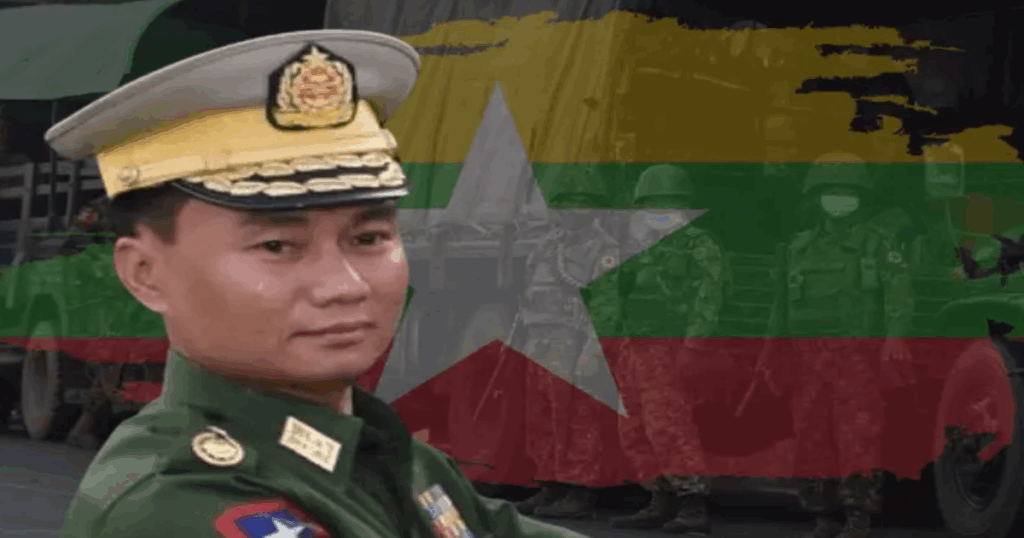



Myanmar’s recent military reshuffle has sparked speculation about the next generation of top commanders, as Senior General Min Aung Hlaing’s rule faces both internal and external pressures amid ongoing conflict across the country.

Since Myanmar’s independence in 1948, the nation’s armed forces have evolved from two regional commands—Northern and Southern—to a complex military structure. By the late 1970s, the Defense Ministry had introduced the Bureau of Special Operations (BSO) to oversee growing regional commands. The first two BSOs, established in 1978 and 1979, were led by Brigadier General Tun Yi and Major General Tin Sein. By 2007, six BSOs managed 14 regional commands nationwide.
However, the 2021 coup drastically altered Myanmar’s military landscape. The junta lost control of large areas and over 100 battalion bases, including two regional commands. Despite limited territorial gains in northern Shan State with Chinese assistance, key cities like Lashio remain under threat from the Myanmar National Democratic Alliance Army (MNDAA). Similarly, in Rakhine State, the Western Command was forced to relocate to Sittwe after losing its base in Ann Township to the Arakan Army.
In late 2024, with backing from China, the regime launched counteroffensives to retake lost territories. Analysts believe last month’s command restructuring reflects both military realities and preparations for a post-election transition.
Military sources confirmed that BSO 6 has been dissolved, leaving five operational bureaus. The most notable change involves BSO 5, which now oversees four key regional commands—Central, Naypyitaw, Southern, and Yangon—spanning Mandalay, Magwe, Bago, and Yangon regions, as well as the capital.
These areas are viewed as the junta’s strongholds, but resistance activity continues in Mandalay, Magwe, and Bago. Urban guerrilla operations have intensified in Yangon and parts of Mandalay, while rural insurgencies persist across central Myanmar. BSO 5 has been tasked with consolidating control over these strategically vital zones.
Lieutenant General Ko Ko Oo, formerly head of BSO 1, has been appointed to lead BSO 5. Considered a close ally of Min Aung Hlaing, Ko Ko Oo is known for his diplomatic role in negotiations with China and the MNDAA regarding border conflicts. Military analysts suggest he is being positioned as a potential deputy commander-in-chief.
Ko Ko Oo, along with Chief of General Staff Kyaw Swar Lin and senior officer Moe Myint Tun, belong to an elite circle of officers who rose through the ranks under Min Aung Hlaing’s leadership. While Moe Myint Tun has been sidelined, Kyaw Swar Lin—an alumnus of the Defense Services Academy’s 35th intake—is widely regarded as the most likely successor to the top military post, with Ko Ko Oo expected to serve as his deputy.
Observers believe this reorganization is part of Min Aung Hlaing’s broader succession strategy. As the military leader nears retirement age, speculation grows that he may soon transfer power. Kyaw Swar Lin is seen as the frontrunner to replace him, with Ko Ko Oo emerging as a key figure in the next phase of Myanmar’s military hierarchy.