











The United States federal government has entered a shutdown after Congress failed to pass a spending bill before the new fiscal year began on Wednesday. The shutdown started at 12:01am Eastern Time (04:01 GMT), forcing nonessential government operations to close.

President Donald Trump has suggested he may use the budget standoff to push for mass layoffs of federal employees, as Democrats and Republicans remain divided over spending priorities. Democrats want to protect healthcare, social programmes and foreign aid, while Republicans are demanding cuts.
The US has experienced 20 funding gaps since 1976, leading to 10 shutdowns. The current budget process, introduced that year, requires Congress to approve spending bills or temporary measures to keep operations running. A shutdown occurs only when a funding gap forces agencies to stop services.
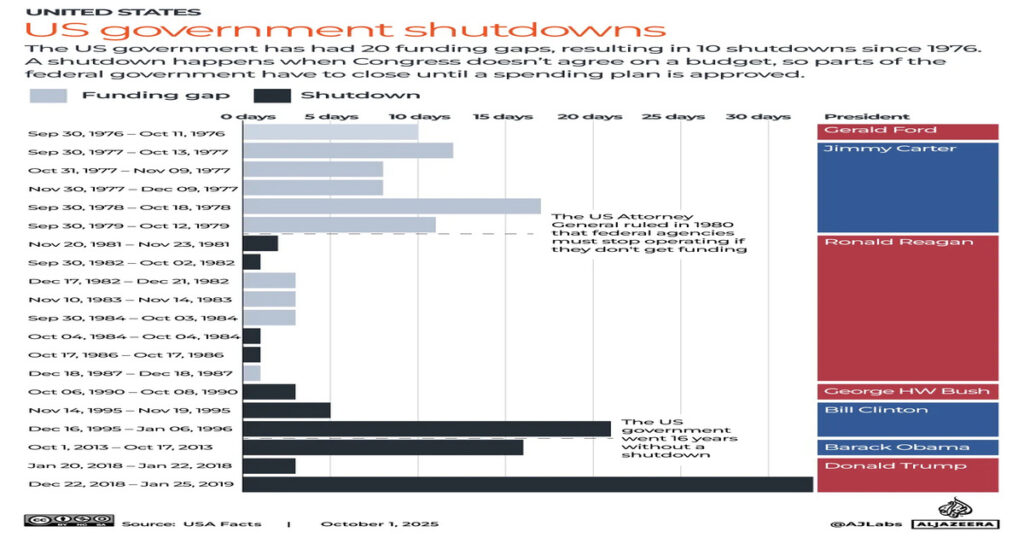
Before the 1980s, funding gaps did not always cause shutdowns, but legal rulings since then have required government agencies to halt operations if Congress fails to approve funding. Only essential services such as national security, air traffic control and law enforcement continue.
The most recent shutdown before now was in late 2018 and early 2019, lasting 35 days. It became the longest in US history, caused by a dispute between President Trump and Democrats over funding for a wall on the US-Mexico border.
During a shutdown, nonessential services close and many federal workers are placed on unpaid leave. Essential personnel, including members of the military, police and air traffic controllers, are still required to work but often without pay until funding resumes.
Shutdowns typically end when Congress agrees on a continuing resolution, a short-term measure that allows time for negotiations on a longer budget deal. Every shutdown since 1990 has been resolved this way.
The impact is significant for the US workforce, as the federal government employs more than 3 million people, about 1.9 percent of the civilian workforce. The Congressional Budget Office has estimated that in the next fiscal year, up to 750,000 federal employees could be furloughed each day, with lost pay amounting to $400 million daily.
Past shutdowns have disrupted services including national parks, museums, research projects, certain benefits processing and taxpayer services. However, Social Security and Medicare payments, military operations, postal services and air traffic control remain unaffected.