













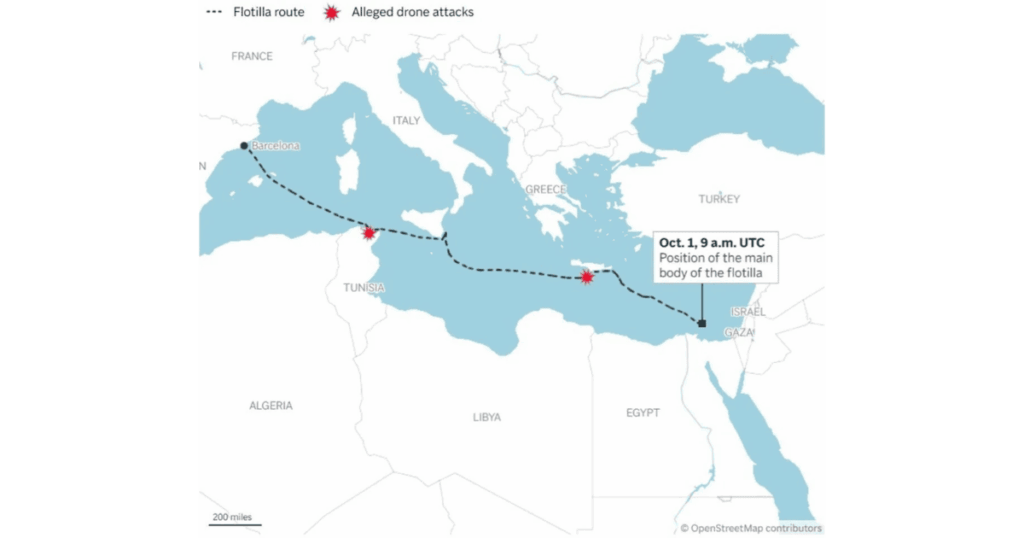
Activists aboard a flotilla sailing toward Gaza said late Wednesday that Israeli naval forces had begun intercepting their vessels as they approached the blockaded Palestinian territory.

The Global Sumud Flotilla, made up of nearly 50 boats and around 500 activists including climate campaigner Greta Thunberg, Nelson Mandela’s grandson Mandla Mandela, and several European lawmakers, has been carrying a symbolic amount of humanitarian aid in an attempt to break Israel’s blockade of Gaza.
Greg Stoker, an American veteran on one of the boats, said about a dozen Israeli naval vessels, with their tracking systems turned off, approached the flotilla. “They are currently hailing our vessels, telling us to turn off our engines and await further instructions or our boats will be seized and we will face the consequences,” he said in a video message while wearing a life jacket.
Israel’s Foreign Ministry confirmed on social media that the navy had contacted the flotilla, warning them they were entering “an active combat zone,” and reiterated its offer to transfer the aid to Gaza through other routes.
The flotilla had entered international waters north of Egypt, a zone where Israel has intercepted similar attempts in the past. Activists reported that two Israeli warships circled two vessels overnight, jamming their communications and disabling live broadcasts. “It was an intimidation act. They wanted us to see them,” said Lisi Proença, an activist on board one of the targeted boats.
Despite the encounter, the flotilla pressed on, continuing to livestream from its boats. By Wednesday afternoon, the mood appeared calmer, with activists broadcasting songs, solidarity messages for Gaza, and chants of “Free Palestine.” Organizers had hoped to reach Gaza by Thursday morning, but admitted Israeli intervention was likely.
Israel’s Foreign Minister Gideon Saar described the mission as a provocation and urged participants to turn back, accusing some of having ties to Hamas. Activists rejected the allegation, saying Israel was seeking to justify a crackdown. Several European governments also appealed for restraint, with Italy warning the voyage could undermine U.S. President Donald Trump’s new Gaza peace plan, while Spain’s Prime Minister Pedro Sánchez defended the effort as a humanitarian mission and promised diplomatic protection for Spanish nationals aboard.
Under international maritime law, states typically cannot seize vessels in international waters, except in cases of armed conflict. Legal experts remain divided over whether Israel’s blockade of Gaza is lawful. Israeli scholar Yuval Shany said that if the blockade is considered militarily justified, Israel can intercept ships attempting to break it after prior warning. But Omer Shatz, an international law expert at Sciences Po University in Paris, argued that humanitarian missions retain protection under international law. “If the basic needs of the population are not provided by the occupying power, there is a right to provide humanitarian aid,” he said, noting Israel would still have the right to board and search vessels for weapons.
The flotilla, which set sail from Barcelona a month ago and has drawn widespread international attention, is the latest in a series of attempts to challenge Israel’s blockade of Gaza, imposed since 2007.

The Israeli Navy has begun intercepting the vessels Samud Flotilla.


